
Allies No More: Why Pakistan and the Taliban Are Turning on Each Other
The border between Afghanistan and Pakistan, a place of tension for decades, has seen both nations erupt into open conflict, exposing the fragility of alliances in the region. What was once a mutually beneficial partnership built from shared interests and mutual enemies has ended in violence, with the future risk of broader regional destabilization. This conflict is deeply intertwined with broader geopolitics, from the aftermath of the U.S. withdrawal from Afghanistan to the rivalry between China and India. To understand why this conflict has escalated so rapidly, it is necessary to examine its historical roots, particularly the boundary that separated the two countries for a century.
Historical Background
In 1893, the British authorities drew the line that separated Pashtun tribal regions and, in doing so, created a modern legitimacy problem between Afghanistan and its neighbor Pakistan. Today, many Pashtun families have relatives on both sides of the line. One side of a family may live in Afghanistan while the other half are legally Pakistani. As Pakistan tightened border control, these everyday movements have become illegal, dangerous, or impossible.
The line was created during a period of rivalry between Russia and Britain, and the British wanted control over Afghanistan to counter the growing Russian influence in Central Asia. Though the British lost the first war with Afghanistan, after the second war, Britain and Afghanistan came to an agreement to install a new Afghan leader, Abdur Rahman Khan. Part of this agreement was for Afghanistan’s foreign policy to be controlled by the British in exchange for the withdrawal of British troops and Afghanistan’s independence. Some years later, to firmly divide Afghanistan from British-controlled India, the British proposed the Durand Line as the official border. Rahman Khan agreed to the British ruling; however, his citizens did not and rejected the official border. As such, after Pakistan inherited the line after the 1947 partition of British India, it also inherited this unresolved dispute, where Afghanistan has consistently refused to recognize it as a legitimate boundary.
This dispute has been reinforced demographically. Pashtuns are the largest ethnic group in Afghanistan but also represent a significant minority in Pakistan. For Afghanistan, rejecting the Durand Line has symbolic value as a defense of Pashtun unity. For Pakistan, on the other hand, it has to do with internal security and sovereignty. This ensures that the border remains a point of friction regardless of which group governs Kabul, including the Taliban, which calls the line “hypothetical” or “imaginary.”
An Alliance Under Strain
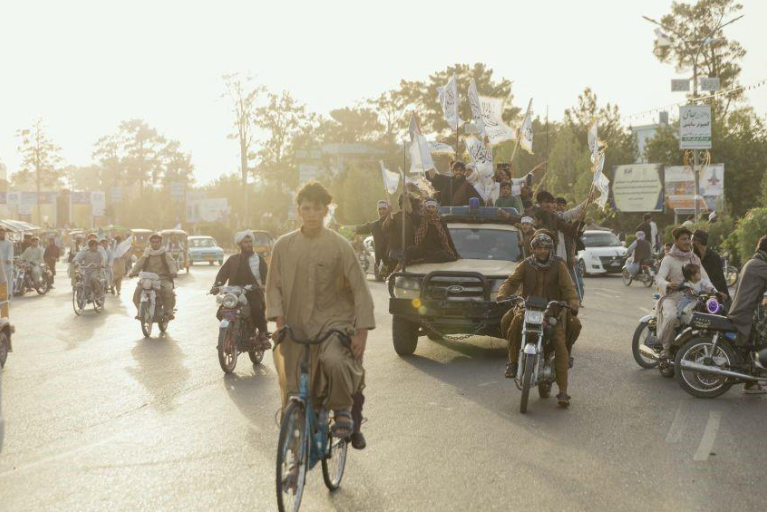
Despite these historical tensions, for much of its existence, the Taliban has been supported by Pakistan, most notably through the alleged Pakistani support during the Taliban’s insurgency campaign against the American-backed Afghan government. For Islamabad, the Taliban served as a counterweight to India, helping prevent the rise of a hostile, pro-India Afghan government. However, this uneasy alignment hinged on the expectation that a pro-Pakistan regime would remain after U.S. forces withdrew.
At first, Pakistan welcomed a Taliban-led Afghanistan, with then Prime Minister Imran Khan proclaiming that Afghans had “broken the shackles of slavery,” However, recent violence in the region demonstrates that the idea that Afghanistan would remain friendly was flawed. Specifically, the October 2025 border clashes and explosions in Kabul indicate that collaborative interests have diverged between the two states. This conflict stems from the Taliban’s support of the Tehreek-e-Taliban Pakistan (TTP), a globally designated terrorist group based in Afghanistan that has been conducting attacks in Pakistan. Pakistan has urged Kabul to restrain the group, but the Taliban have shown little willingness to intervene, even denying the presence of these militants as its support for the group increases.
What is the TTP?
TTP, also known as the Pakistani Taliban, emerged in 2007 from the Pashtun ethnic group in Pakistan and has become a serious national threat to the country. Most of the group’s actions have been towards the Pakistani military, but violence against civilians has also increased in recent years. Its main area of activity is centered within the formerly Federally Administered Tribal Areas (FATA), a semi-autonomous region in northwest Pakistan, but it was officially merged into the Khyber Pakhtunkhwa province in 2018. One of the main reasons for the TTP’s existence was to remove foreign troops from ‘their’ lands. However, after the U.S. withdrawal from Afghanistan, its primary aims have shifted to the establishment of a Sharia-based legal system within Pakistan’s tribal areas, in addition to the restoration of their previously semi-autonomous status.
How does India factor in?
India has a long, complex history with Pakistan. After the British pulled out of British India, two countries were formed out of what was the British Raj: India, being majority Hindu, and Pakistan, being majority Muslim. Several wars were fought between the two countries over the territory of Kashmir; additionally, conflicts were waged that resulted in the creation of Bangladesh, which revolted against West Pakistan. Relations between the two nations, which both possess nuclear arsenals, remain frayed and volatile today, with a military confrontation erupting in spring of 2025 sparked by a militant attack in Kashmir that resulted in the deaths of 25 Indian tourists.
India’s relationship with the Taliban has long been adversarial, shaped by fundamental ideological differences and diverging interests. India had supported the U.S. backed North Alliance against the Taliban, while the Taliban were seen as complicit in the hijacking of an Indian airline in 1999 and the attack on the Indian embassy in Kabul in 2008. India is also cautious of the Taliban’s harsh Deobandi interpretation of Islam, an ideology held by several militant organizations hostile towards India. Ideological differences were quite visible when, during the press conference with Muttaqi, there was an absence of female journalists. This is no accident, as women’s rights are being systematically dismantled under the Taliban; they are denied education, economic participation, freedom of movement, and a voice in society. This extreme gender-based oppression contrasts the situation in India, a country where women are not denied opportunity based on gender.
Despite these glaring differences, India has recently put effort into resetting its relations with the Taliban. This diplomatic thaw was highlighted by the visit of the Afghan Foreign Minister Amit Khan Muttaqi to India in October 2025, during which India declared they would reopen its embassy in Kabul. This comes during a time of anxiety for India, marked by skirmishes with Pakistan, border tensions with China, warming ties between Pakistan and Bangladesh, China’s growing support for Pakistan, and a shrinking circle of reliable partners in its neighborhood.
A rapprochement between Delhi and Kabul has the potential to benefit both sides as each has lost political friends on their respective peripheries. The Taliban would like to add a counterweight against its former ally, while Delhi would like to secure economic access to Central Asia and to have warmer relations with surrounding countries. Central Asia has been historically a major trade hub due to its location as the heart of the ancient Silk Road. China’s Belt and Road Initiative (BRI), sometimes referred to as the New Silk Road, which aims to connect and build trade links across the world, sees Central Asia as a major part of its plan and has given huge amounts of funding to countries in the region. By building influence in Central Asia, India would also counterbalance China’s growing influence in the region.
Eruption of War
On February 26, Pakistani military bases were targeted in an attack launched by the TTP Taliban. In response, Pakistan initiated a wave of bombings across several Afghan provinces, including the capital. This marked the first incident in which Pakistan deliberately targeted Afghanistan’s urban centers. Following these attacks, Pakistan’s Defense Minister declared that the nation is in a state of “open war” with Afghanistan, which is an unprecedented escalation.
This conflict is likely to add further instability into an already fragile region. Both Afghanistan and Pakistan face severe internal challenges, including economic distress and political volatility. An escalating military confrontation between the two will almost certainly displace civilians, weaken border controls, and provide extremist organizations with the opportunity to expand their regional influence.
The situation is further complicated by Afghanistan’s border with Iran, a nation currently embroiled in its own conflicts with the United States and Israel. Afghanistan is facing additional strain from this neighboring friction, as trade routes through Iran become increasingly uncertain. Due to its fragile economy and continued alienation from the international community, Afghanistan poses a significant risk of becoming a primary driver of regional and global instability through terrorism, refugee crises, and narcotics trafficking.
Conclusion
There’s a common saying that countries have no friends, only interests, and this geopolitical anecdote is representative of the emerging relationships among India, Pakistan, and the Taliban. Geopolitics is tricky; it is a game where alliances and interests are constantly shifting, where adversaries constantly seek to outmaneuver one another. Alliances are not always born from shared beliefs; they are often forged by necessity.