Surging Gold Prices: A Signal of Escalating Global Economic Uncertainty
Abstract
Rising gold prices reveal deepening fears over trade wars, inflation, and the future of dollar dominance. Driven by escalating tariffs, rising US deficits, dollar weakness, and expectations of Federal Reserve rate cuts, investors are increasingly turning to gold as a safe haven. The metal’s rapid ascent now reflects not just market volatility, but a broader erosion of confidence in US economic leadership and the stability of the global financial system.
Gold’s Role as a Safe Haven Re-Emerges
Gold is commonly known to act as a safe investment, often increasing in value during times of market turbulence or economic downturns. Consistent with this pattern, investors have recently sought safety in gold amid heightened global political and economic uncertainty, driven by current geopolitical conflicts, anticipated Federal Reserve adjustments, and ongoing trade tensions. This continuing surge in gold prices reflects the impact of investor uncertainty and worries about the current global economic and political state of the world on markets.
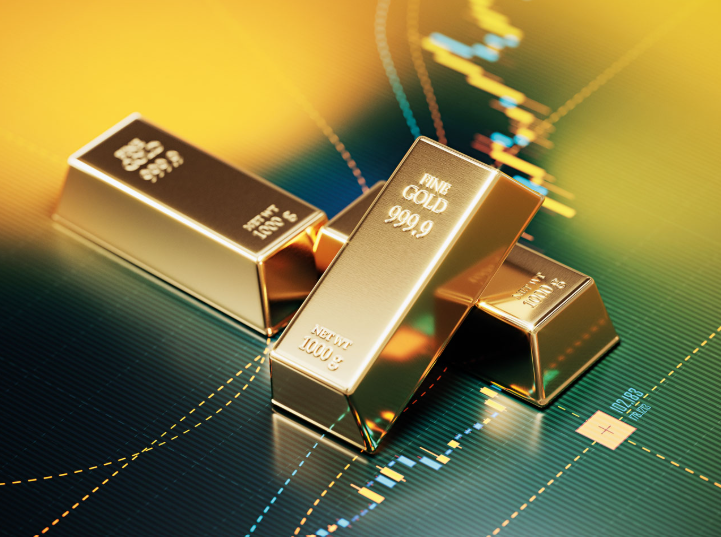
Over the past few months, gold prices have reached a record high, surpassing $4,000 per ounce, with a more than 50% increase this year alone. The speed of this ascent is particularly noteworthy; the price climbed from $3,500 to $4,000 per ounce in just 36 days, a stark contrast to the previous average of 1,036 for a previous $500 increase.
Policy Shocks Drive the Latest Surge
Analysts at the Bank of America and Société Generalé expect gold to reach above $5000/oz by the end of 2026. Gold prices, which had already experienced significant increases throughout the year, began rising even more sharply from April onwards, coinciding with Donald Trump’s announcements of new tariffs on imported goods, including his unveiling of “Liberation Day.” This surge can be attributed to three distinct but interconnected mechanisms: heightened market instability and uncertainty surrounding Trump’s policy agenda, elevated inflation expectations triggered by tariff implementation, and significant depreciation of the US dollar driven by fiscal concerns.
Trump’s US trade policy has introduced volatility across markets, prompting investors to seek stability in gold. Initially, the lack of precise information regarding Trump’s tariff policy, specifically, the scope of affected goods and entities as well as the timeline for implementation, generated substantial market uncertainty.
Government Shutdowns and Policy Uncertainty
This instability has been further exacerbated by the recent US government shutdown, which has intensified investor uncertainty, particularly regarding potential Federal Reserve interest rate adjustments and the outlook for the US dollar. The shutdown resulted in a delay of key economic reports such as the employment report of October 3rd, thereby creating a lack of data that has intensified market anxiety. This heightened instability aligns with historical trends, where gold has consistently acted as a safety net for investors; for example, its price climbed by nearly 4% during the month-long shutdown in Trump’s first term, a notable surge for such a brief period, demonstrating the metal’s established role as a secure asset during turbulent periods.
The announcement of Trump’s tariffs raised inflation expectations amongst the economy, with investors anticipating a depreciation in their purchasing power. Given gold’s independence from any single currency and its historical propensity to retain value during inflationary periods, investors have been motivated to acquire gold as a hedge against wealth erosion, thereby driving its price upward. These concerns have been compounded by fears that government spending will increase post-reopening, further increasing inflationary pressures and solidifying gold’s appeal as a store of value in an environment where traditional currency-denominated assets face erosion of real returns.
Trump’s tariffs alongside his “Big Beautiful Bill”’ have substantially weakened the US Dollar, having dropped 10.8% during the first six months of 2025 - its worst performance for this period since 1973. This depreciation made gold more affordable for international buyers, as the dollar-priced metal became cheaper in foreign currencies, thereby boosting global demand. The decline in the dollar stems from a combination of Trump’s tariff policies, straining global trade, as well as America’s huge swelling debt load/ Trump’s ‘One Big, Beautiful Bill’ could add over $3.9 trillion to US debt. With fiscal deficits widening, Moody’s has downgraded the US credit rating, further fuelling gold’s appeal as a safe, long-term asset that remains insulated from sovereign credit risks and currency debasement.
Escalating Trade Tensions and Rate Cut Expectations
In light of these developments, gold prices are anticipated to continue rising in the coming months, reflecting persistent investor concerns. The market has recently seen a rally in gold, fueled by Donald Trump’s warnings regarding potential fresh tariffs on China. Following China’s announcement of expanding export controls on critical rare earth materials, President Trump threatened to impose 100% tariffs on US-bound goods from China and warned of new US export controls on ‘any and all software’ by November 1. Such statements have reignited fears of escalating international tariffs and the potential for a trade war between China and the US, causing stocks to suffer their worst losses since the height of Trump’s April tariffs.
Traders are now pricing in a 97% probability of a 25-basis-point Federal Reserve rate cut this October, with a 100% chance for December. A fall in interest rates typically amplifies market uncertainty for investors and can diminish purchasing power. As a non-yielding asset, gold tends to perform well in low-interest-rate environments. These anticipated rate cuts provide support to riskier assets and further weaken the dollar, both of which ultimately benefit gold. The expectation of multiple cuts throughout the coming months thus positions investors to increasingly turn to gold as a hedge against inflation, currency depreciation, and market volatility.
A Structural Shift in Global Confidence
The current surge in gold prices stands apart because multiple crises are hitting at once: extreme dollar weakness, disruptive trade barriers, and the ballooning deficits. The dollar’s sharp decline since the start of 2025 isn’t just elevated government spending; it is a fundamental shock to global finance. The implications are captured in recent comments from JPMorgan Chase CEO Jamie Dimon, who noted: “I’m not a gold buyer- it costs 4% to own it. But it could easily go to $5,000 or $10,000 in environments like this. This is one of the few times in my life it’s semi-rational to have some in your portfolio”.
Trade deals, higher interest rates, and fiscal discipline could reverse this trend- but the political will is missing. The Trump administration has resisted trade compromise, pressure the Fed to keep rates low, and pushed tax cuts that worsen deficits. For investors and policymakers, the gold market now measures confidence in the dollar’s global role- and the signal is troubling. If gold reaches the levels Dimon describes it, it won’t just be a profitable trade. It will mark a historic shift away from dollar dominance toward a more fragmented financial system.