
Nvidia and Jensen Huang: Tech’s Unstoppable Force Meets the Immovable Predicament
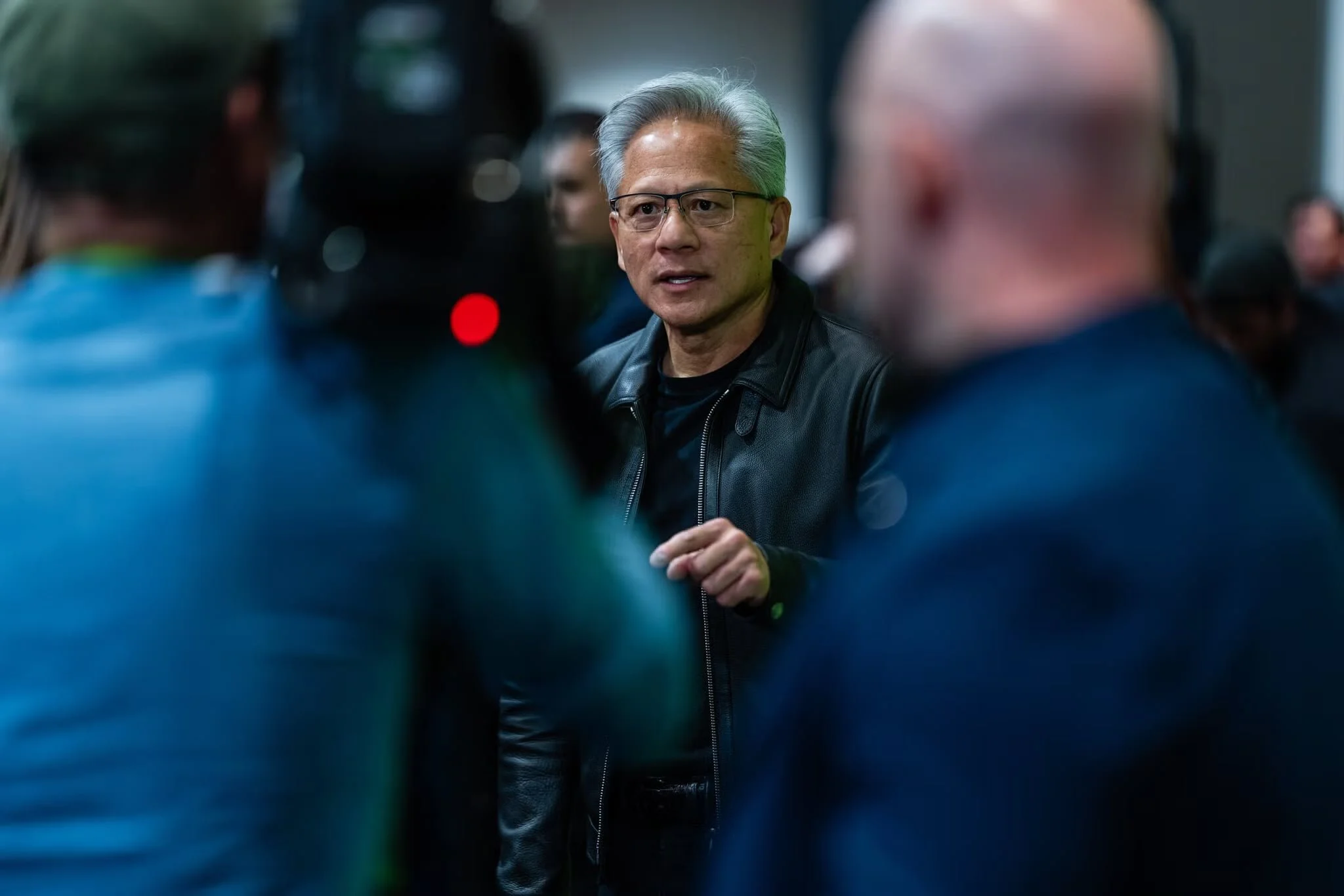
On November 8th 2026, an internal statement was released to Nvidia (NASDAQ: NVDA) by co-founder Jensen Huang, the CEO, prominent board member, and face of the company. In the memo, Jensen apologized and took responsibility for his infidelity to his wife, pledging to earn back the trust of Nvidia stakeholders and his family. Since then, a series of cascading events has unfolded, including the news of a second extramarital relationship between Jensen and one of his direct reports. This led to Nvidia's board of directors' serious consideration of removing Jensen and his subsequent resignation on November 12th, before his ultimate reinstatement on November 23rd. The future of Nvidia, Jensen, and AI growth was left in a temporary state of limbo, creating questions that have deeply impacted the market.
Early Nvidia
The beginnings of Nvidia were humble and unprescriptive of the future successes of the company, to say the least. Jensen founded the company while working at LSI Logic, engineering semiconductors, alongside Chris Malachowsky and Curtis Priem, who were building custom chips for the workstation manufacturer Sun Microsystems. Jensen was assigned to work with them, forming a close bond while building the first iterations of a graphics card while many companies were focused on central processing units (CPUs). After design misalignments between Sun Microsystems and Chris and Curtis, they decided to start their own company to take advantage of the coming PC revolution. They first thought to ask Jensen to join, having regular meetings at Denny's, where Jensen first worked as a dishwasher. At this point, computers were essentially text terminals with no graphics capability. They decided to create 3D graphics chips for the application of video games on a personal computer, an unproven market contrary to the existing 2D graphics landscape. Jensen's first-principles approach led him to the decision to leave LSI Logic and focus on the venture. Jensen believed that if you break the venture down to the beliefs you have in the market and the shift in computing, and the signals skew positive, you should take advantage of the opportunity. Jensen was directed by the head of LSI Logic to Don Valentine for seed investment, who said, "If you lose my money, I'll kill you." This gave them their start in a small office at a strip mall with 20 employees.
Nvidia first developed the NV1 chip, 2 years after founding. The market violently rejected their first product, not due to invalid technology achievement, but because it operated as an overpriced Swiss Army knife. The NV1 had no application use, but included 3D graphics, audio processing, video processing, a game port, programming, and other features not needed in confluence at the time. 250K units of NV1 went out, and 249K came back, practically putting Nvidia out of business. While the company was on the edge, they took a contract to design NV2, the graphics system for Sega's next game console. However, during this time, the 3D graphics market had accelerated and shifted to inverse texture mapping, a more efficient architecture used by the new Windows 95. Spending the time to finish the Sega contract built on irrelevant architecture would make their deficit to competitors insurmountable. Breaking the contract would mean the company surely runs out of money and goes bankrupt. When faced with this impossible decision, Jensen visited Sega (6460.T) in Japan and outlined the situation to their CEO. The only option was to ask to be let off the contract and be paid in full, with no benefit to Sega. The company only still exists today because of Sega's kindness in helping Jensen and Nvidia by providing the $5M for a small stake in the company as a lifeline. Nvidia was far from being saved entirely. This created one of Jensen's signature mantras and operating principles, "We're only 30 days away from going out of business," used consistently to create a sense of urgency, spark innovation, and push timelines forward. At this point, Jensen knew the company would fail if they did not produce a mass-market chip that worked perfectly on first production. The problem was in the way a successful chip is built. To create a chip, there was a process: design, manufacture, write the software, find bugs, iterate, and manufacture again. Nvidia had to get it right with the first manufacturing run or run out of money. Jensen took the lead in suggesting they work backwards and write the software in advance. He contacted a recently failed company that built a fridge-sized emulator demonstrating a chip's performance before manufacturing; he bought their only product in inventory. Nvidia and Jensen changed the fundamental way that chips are designed because of this, and created the NV3 in 1997, a nearly perfect product with comparatively ridiculous performance that revolutionized computer graphics and sold 1 million units in 4 months.
With their manufacturing advantage, Nvidia would then release the GeForce 256, the first graphics unit with hardware transform and lighting. The capability of this combination was undeniable and led to GeForce being chosen to power the Xbox; the video game industry exploded in popularity as a result. This was considered the world's first Graphics Processing Unit (GPU), sold directly to customers rather than just through inclusion in a console. Nvidia enjoyed success until competitors caught up with the technology in the mid-2000s. In 2006, Nvidia released CUDA, a step towards general applicability of their graphics cards for deep data processing and neural networks. CUDA was a programming interface for Nvidia GPUs with seemingly endless applications, including molecular dynamics, seismic processing, CT reconstruction, image processing, and more. Eventually, it was discovered that an array of GPUs with CUDA capability resembles a supercomputer and can be used for deep learning. This would speed up the ability to train neural networks due to the capability to parallel process thousands of tasks, making AI training possible. Eventually, this would lead to image recognition capabilities in computers, with training involving the synthesis of thousands of pictures being shown to computers in a recognizable form. The AI models of today are an extrapolation of the advancements started by CUDA over time. The decision to pursue the AI market so early is characteristic of Jensen's appetite to "invest in zero-billion-dollar markets." Nvidia was a public company at this time and financially viable; however, faced with parity with competitors in the GPU market, Jensen and the company decided to create a completely new market. This was an unprecedented and illogical pivot looking forward at the time, due to added cost and new personnel; however, the courage and vision of Jensen gave him the conviction to commit Nvidia to AI.
Hypergrowth
Jensen's commitment to AI created nothing short of technological revolution and exponential growth for Nvidia; likely one of the most successful technological bets and company shifts of all time. Nvidia backed this bet with $12B in R&D expenses throughout 2006-2017, mainly to develop the power of CUDA. Despite the clear technological achievement, there was a long period with little to no adoption of CUDA. The highly capable technology seemed to have few use cases, akin to the lack of adoption when Nvidia took NV1 to market years before. Entering the 2010s, CUDA downloads were slowing, and investment costs were piling up. CUDA was making Nvidia chips more expensive for consumers who did not need its practicality. In 2012, a breakthrough was reached by two University of Toronto students who trained a visual-recognition neural network called AlexNet with Nvidia GPUs. The program was able to recognize over a million photos and sort them into their respective categories with a slim error margin. AlexNet demonstrated the application of Nvidia GPUs in training machine learning models more efficiently than CPUs and allowed Nvidia to double down on AI with their revenue from gaming. Continued R&D allowed Nvidia to release the DGX-1 supercomputer in 2016, a system specifically designed for deep learning, allowing development of Large Language Models (LLMs). A tripling in stock price followed. OpenAI (OPAI.PVT) was the first customer for the DGX-1, receiving a donation from Nvidia that same year and later used similar architecture with Nvidia GPUs to launch the popular LLM ChatGPT in 2022. The astronomical success of ChatGPT, the fastest-growing consumer application to date, was built on infrastructure from Nvidia, which gathered parallel success and investment appetite. Earlier in 2022, Nvidia released the H100 chip with faster training and better performance compared to the DGX-1 and previous A100 chip, which was immediately delivered to Alphabet (GOOG), Amazon (AMZN), and Microsoft (MSFT). At this point, generative AI seemed to be reaching escape velocity as a technological concept, and many were projecting an incredible amount of tangible use across industries. Following a series of multiple astounding earnings reports, Nvidia became the world's most valuable company at $3.3T in 2024, the same year they announced their next chip, Blackwell.
2025 would prove to be one of legislative tailwinds and headwinds. In April 2025, President Donald Trump banned exports of Nvidia's H20 chip to China in a move to hinder Chinese AI development amid the growing AI arms race between the nations. Three months before, Trump announced Project Stargate, a multinational joint venture to build a half-trillion dollars' worth of U.S. AI infrastructure between OpenAI, SoftBank (9984.T), and Oracle (NYSE: ORCL), built on Nvidia technology. Stargate would exemplify the growing interdependence between AI companies.
Although Nvidia became the first $5T company in late 2025, questions were being raised around the circular wheel of AI deals that Nvidia is at the core of. Essentially, AI chips and cloud compute deals and investments have been circulating between a closed list of companies, where the money a company puts into a customer comes back to it as revenue. For example, Nvidia agreed to invest up to $100B towards OpenAI data centres being filled with Nvidia chips. The guaranteed sales and padded revenues for Nvidia in a deal like this seem to be inflating the company's bottom line and valuation. This has caused questions about AI spending inflating an AI bubble propping up valuations for companies like Nvidia, OpenAI, Microsoft, Oracle, AMD (NASDAQ: AMD), CoreWeave (NASDAQ: CRWV), xAI (NASDAQ: SPCX), and others, which have disproportionate revenues outside of investment from other AI companies. Additionally, it is clear that the U.S. government is beginning to play a larger role in the circular structure, with legislative power to build infrastructure and recently taking a 9.9% equity stake in Intel (NASDAQ: INTC). The CHIPS Act, which allows this, shows how important chips are to domestic AI superiority and national security, while explicitly demonstrating the use of public funds in the AI economy.
After being a pure chips company for the majority of Nvidia's lifetime, it recently made a bet on models, specifically open-weight models. This runs contrary to the status quo concentration in largely closed models from companies like OpenAI, Anthropic (NASDAQ: ANT), and Google. Earlier this year, in September, Nvidia agreed to acquire Hugging Face, a platform with truly open AI, where millions of developers have built millions of models and applications fine-tuned to the use case of the developer. This offers an opportunity for enterprises to develop internal AI models as a low-cost alternative to frontier options, with similar quality, validation of internal data, and safety assurance. Hugging Face was previously struggling with operational costs of running their models as a comparatively small company to Nvidia, which could bankroll their open-weight development. Interestingly, Nvidia would benefit only from general widespread compute demand tied not to any one model; millions of specialized models would generate more compute and demand for Nvidia chips in aggregate. Unsurprisingly, this created friction as Jensen's open advocacy for open weight and de-concentration could undermine proprietary AI models like ChatGPT that are baked into the economy through legislative direction.
Leadership
Jensen Huang has a few quirks as a CEO and leader that Nvidia's 'Jensanity' could be attributed to, including flat company structuring, information sharing, and his selection of bets. Jensen had about 60 direct reports at Nvidia , which he has personally described as exhausting; however, he believes this level of responsibility is important for the position of CEO to ensure a flat hierarchical structure of power where everyone has the same information available to them. His view is that managers exist to serve employees and create conditions for their work. The intradependence in the company and the volume of management decisions run through Jensen allow the company to maintain their purpose and not copy competitors when looking for solutions. Another core belief of his is that you can be empowered if you understand the circumstances, exemplified by how Jensen shows people how to reason through things from first principles no matter the person or situation. This creates an environment where many look to Jensen for guidance and, as a result, the majority of decisions are made through him.
As CEO and leader of Nvidia, Jensen resiliently held his and the company's core beliefs and bets close to his heart, maintaining vision even through choppy waters. It is clear he fundamentally has a strong distaste for complacency in the realm of innovation and values the importance of work, leading indicators, and turning problems into markets of novelty, based on first-principles logic. A leader of Jensen's stature removed from Nvidia would have came with an extremely large organizational void where there is a connection and sharing of company knowledge, as well as a vision compelling Nvidia to the highest peaks of tech.
The Scandal
On October 29th, 2026, an executive at Megaspeed, Alice Huang, who had been under investigation for importing Nvidia AI chips to China, was reported to be a Chinese intelligence asset who formed a close relationship with Jensen. This news was alarming due to the ongoing AI race between the U.S. and China and was initially framed as potential espionage directly from Beijing. A connecting link between Jensen, potentially the biggest leader in U.S. AI as well as a government ally, and China could have devastating impacts for U.S. national security and AI superiority. About a year ago, Trump was briefed on what had been found about Alice Huang and potential illegal exports, ultimately deciding to leave Nvidia's operations alone. Jensen was not briefed on the possibility that Nvidia could be a target of foreign intelligence by way of Alice Huang. Initially, Nvidia's stance was that the Singaporean data center company Megaspeed was a typical customer in the region, and Jensen's relationship with Alice Huang was typical of that between a customer of Nvidia and him. Interestingly, during Trump's second presidency in 2025, Jensen had lobbied successfully for the loosening of restrictions on chip sales to China and allowed the government to take a 25% revenue stake in H200 chips sold to China. Still, things are unclear about the situation at large; namely, whether Jensen was not briefed to not risk alerting Alice Huang, why investigations began, or what she may have passed along to China.
The headline development came November 8th when Jensen made his affair with Alice Huang public through a company memo, apologizing for his actions. This is when the evidence stacked up to build the narrative that Jensen was the victim of a Chinese honeypot. In Trump's account, Jensen has since stated that he did not know she was a spy. China denied that any espionage took place. Immediately, Nvidia's board of directors, without a chairman, launched an investigation into the situation and any communication of company secrets. Over the next two days, Nvidia shares fell 9.5%. By Nvidia's code of conduct, any personal relationships causing conflicts of interest must be disclosed. From the board's perspective, if Jensen had not disclosed the relationship and it was found to have created a conflict for the company, removal would be appropriate.
Taking a broad perspective, it is the U.S. government's view that it should avoid placing limiting enforcement on the companies driving American AI growth, like Nvidia with its chip distribution. As a byproduct, this gives asymmetrically higher power to industry over legislation, and allows Nvidia, in a position of leverage, to take advantage of government deference. Jensen, a close ally of the President, had been appointed by Trump earlier this year to join the President's Council of Advisors for technology consultancy. This ongoing government influence is likely what created the possibility for Nvidia to loosen restrictions on Chinese chip sales, arguing that the shipment restrictions were a counterproductive policy forcing China to develop chips domestically.
The developing saga of the investigation into Megaspeed and Nvidia has put a direct spotlight on this issue and raised questions around the government's loose grip on the situation. The U.S. Commerce Department had begun investigating Megaspeed in 2024 when $7.5B in Nvidia AI chips were being exported to Megaspeed data centers in Malaysia. This is legal; however, the data centers were servicing Chinese clients like Alibaba (HKG: 9988), and there was concern that some chips were being sent to China. Nvidia's general counsel, Tim Teter, reached out to an official at the Commerce Department, Jeff Kessler, last year, which suddenly caused the case to be transferred to the Justice Department around the same time. Contrary to standard procedure, Kessler had given Teter permission to reach out about the details of the case, giving agents in the department the view that the case had been tainted. The sudden shift up in department caused a glaring red flag and inspired questions around the discussions between Nvidia and the Commerce Department, and what Washington knew that we didn't, once Jensen's affair was made public. Once the Justice Department had possession of the case, it continued working its way up to Secretary of State, Marco Rubio, who prepared an intelligence memo and warned Trump in Spring 2026. If truly jeopardized, transferring the case to the Justice Department would avoid the entire case becoming compromised and allow criminal penalties, rather than just fines, against Megaspeed, to be pursued. Although the Justice Department requested to take over the case, it may have stopped the Commerce Department from cutting the chip shipments quickly. The November 9th letter sent from the House Foreign Affairs Committee to the Secretary of Commerce with questions pertaining to the case can be found here.
In hindsight, the debate is whether the U.S. should have allowed free AI trade with China, creating a free market where the chips of domestic Nvidia become the status quo, or diligently cut exports to China entirely, allowing the best infrastructure in the U.S. only. Each respective stance has pros and cons; however, it is likely that demand from Chinese companies would only strengthen Nvidia and directly cause deviation from the Chinese government as they push for sovereign AI development. Instead, the chosen path through the middle ground, possibly resulting in the Jensen scandal and opening Nvidia to vulnerability, is where we have landed.
The Ousting of Jensen Huang
By November 11th, 2026, more damning evidence was building up against Jensen Huang. It was uncovered from anonymous sources that Jensen had a second affair, this time with one of his direct reports, Kimberly Powell, the vice president of healthcare at Nvidia. Powell had been rising up at Nvidia, going from senior director of AI business development to vice president of healthcare, applying the technology to medical imaging devices. It was months ago, in March, that the two were captured on video being publicly affectionate at a California hotel, with the bystander being offered to sign an NDA. More recently, amid the bubbling-over controversy, a reporter reached out to Jensen by phone about Powell; he said, "I don't think you should be talking to me directly." He hung up the phone. This affair would surely create a conflict of interest at Nvidia and give Jensen another big strike against the company's code of conduct, although the same anonymous sources claimed their relationship was openly discussed at the company.
The inopportune timing of the second affair news led Nvidia's board of directors to meet and prepare for the removal of Jensen, at a time when he was already facing external pressures from U.S. lawmakers to step down. Previously, the board of directors outright expressed confidence in Jensen, but this final nail in the coffin made this meeting and removal mostly obligatory. Nvidia shares fell more than 8% during after-hours trading the night of the 11th, while potential beneficiaries such as AMD gained 4%.
The next day, November 12th, 2026, Jensen announced that he would step down as CEO and as a member of Nvidia's board effective immediately. Facing unprecedented circumstances, Nvidia had no succession plan in place, and CFO Colette Kress would serve as interim CEO until a solution was found.
The widely congruent initial reaction across stakeholders, industry leaders, and employees to the new post-Jensen Nvidia is deep uncertainty and pushback. For a leader to be removed who is so absurdly central at the company which is vital to the development of AI, people start to wonder if technological development will ever look the same. In an attempt to bargain with the circumstances, thousands of Nvidia employees rallied for the reinstatement of Jensen. The company's internal forums saw upwards of 1,600 comments in support of reinstatement. One Nvidia employee wrote in a companywide email, "I stand by Jensen. Not because I believe any person is infallible, but because I refuse to believe that standing for fairness must mean standing at a distance from someone whose leadership has meant so much to us." In addition, Altimeter Capital and Atreides Management, two massive Nvidia shareholders, signed a letter suggesting that Nvidia should "pursue a slow, measured, and deliberate process regarding the future leadership of Nvidia." The general attitude towards the departure of Jensen could be best exemplified by the Stand with Jensen campaign, said to be independently created by current and former Nvidia employees. The campaign includes a letter asking the board to reinstate Jensen as CEO unless it can be factually proven that his departure would be in the best interests of Nvidia. The letter also asks Nvidia to disclose the expected timeline of the investigation, scope, explanation of concerns with evidence, and to give Huang a chance to respond before the decision. No evidence has been shown publicly as to why Alice Huang must have been working for foreign intelligence, and this has contributed to fears of removal without due process.
Among the 150,000 people who have signed the letter, 7,500 are proclaimed to be current Nvidia employees, and Elon Musk, who publicly said he gave his signature on November 13th. Musk, the founder and CEO of Tesla (NASDAQ: TSLA), SpaceX, and multiple other high-profile organizations, has given his support to Jensen across multiple tweets, knowing him as a person and having made deals together. On November 14th, Musk praised Jensen's proficiency as CEO of Nvidia on X, saying, "Jensen drove supply chain brilliantly at Nvidia, but many of those deals were a handshake with Jensen, not a written contract. Without Jensen, at least some of those critical deals will be lost." The volume of support for Jensen from employees, leaders, and eventually government, with Trump personally intervening with the Nvidia board, created an insurmountable pressure that led to Jensen’s reinstatement.
Market Value Wipeout
As one may expect, a company losing its CEO and founder may be grounds for bearish sentiment around the equity. Calling Nvidia's subsequent stock price movement a drop would do injustice to the magnitude of value that slipped away from the company in the period that followed. Nvidia has this invisible goodwill on its balance sheet in the form of Jensen Huang, who was potentially the largest factor in the company's preceding success with innovation. The scandal did no good for Nvidia stock, already in decline following rising interest rates and the Democrats' victory over the House of Representatives and Senate, putting the continuation of AI infrastructure investment into question. In culmination, Nvidia has recently seen its longest losing streak since 2012 with seven continuous negative weeks, wiping out $2.6T of market capitalization. $1.16T of this loss came after Jensen stepped down as CEO.
In technical terms, there is an argument that most of the post-Jensen losses have been almost entirely tied to his departure. This $1.16T figure could answer what Jensen was worth to the company from a purely financial perspective. It is still unknown how an absence of Jensen would affect the company at an operational and directional level. With an astounding 60 direct reports and an influence causing people to treat the idea of Nvidia and Jensen as analogous subjects, this void in leadership and product vision could have left a shell of former Nvidia. As a result, Nvidia could have been left at status quo as a company, with only incremental growth compared to the previous exponential growth. This is without mentioning the potential of company secrets having been exposed to Chinese AI companies, providing unwanted empowerment.
Immediately, the market priced in this negativity with a 14.4% intraday low on November 12th, and a 13% drop in the stock price over the week, which included the news of both affairs and Jensen's resignation as CEO. A long repositioning period was expected with Colette Kress as interim CEO while a succession plan was formed. Because of this, multiple Wall Street analysts downgraded the stock, one of the largest being Evercore ISI's (NYSE: EVR) price target drop from $465 to $186. Multiple other downgrades came from Baird, William Blair, Oppenheimer (NYSE: OPY), and others, among mass price target cuts across the Street.
It is clear that from a market standpoint, the scandal involving Jensen is comparatively one of the harshest market reactions involving a CEO. In a 2016 study from Stanford that examined the effects of personal and behavioural CEO incidents, including affairs, the average underlying stock only fell 3% adjusted to the market over the following three days. One of the largest previous drops was Hewlett-Packard (NYSE: HPQ), which fell 9% over the three days following news of the CEO's relationship with a female contractor. Compare this to Nvidia's 10.1% 3-day drop, and the depth of the situation is clear. Interestingly, the study found that a minority of fired CEOs were rehired, proving the possibility of reinstatement; however, the damage to reputation lasts much longer after the stock drop.
Identity
Few CEOs have built markets from zero to billions based on conviction alone, where conventional wisdom would've suggested simpler paths assuring steady growth. Jensen was one of the few visionaries who accomplished this feat, putting a company of thousands of employees into a state of dedication to the mission, even during plateaus and downturns. This intangible ability is perhaps the rarest commodity in leadership, and Jensen put it towards hitting one of the biggest home runs in technology, developing the grounds for AI to flourish. To say that the future of Nvidia without Jensen would leave big shoes to fill at CEO is an understatement, and Nvidia would need to find their next visionary to maintain its allure.
Upon Jensen’s brief hiatus, Nvidia's next big market seemed to be on the horizon with open-weight models, physical AI, and agentic AI. Before Nvidia agreed to acquire Hugging Face, Jensen publicized a policy letter signed by Nvidia as well as many of tech's largest companies, including Microsoft, Meta (NASDAQ: META), IBM (NYSE: IBM), Palantir (NASDAQ: PLTR), and others. The main premise of the letter is a call on U.S. governance to avoid premature restrictions on downloadable AI models. One of the specific policy suggestions is to expand access to compute for startups and researchers, while funnelling public investment into shared datasets and evaluation frameworks. All in all, Jensen clearly had a vision for U.S. businesses and consumers to eventually use AI sovereignly based on frontier open models. In layman's terms, this could be likened to everyone and every organization having their own AI model. Not only would this make models more intuitive to each user, but it would also decentralize and democratize AI model use away from the few companies dominating market share, including OpenAI, recently public Anthropic, Google, and others.
Multiple other AI revelations of Jensen's have seeded new innovations coming from Nvidia, stemming from the recognition of tokens as the world's future most valuable commodity. As AI is agentically given "hands" to complete tasks and act on a user's computer or in the real world, it must infer and reason, expending tokens in the process. Jensen compared agentic AI, like OpenClaw, to the rise of operating systems like Mac and Windows, where personal AI would be like the personal computer. His personal belief in physical AI, where agents are translated into robotics to act in the real world, led Nvidia to release Cosmos 3. Cosmos 3 is a simulated training module for physical AI which allows synthetic world generation with vision reasoning and action, allowing robots to learn in a simulation inconsequentially. In a world where token generation becomes so valuable to technological productivity, the data centres that produce tokens earn a certain significance as a potential limiting reagent in the AI equation. To support this infrastructure shift, Nvidia recently unveiled BlueField-4 STX, an advanced storage architecture for incredibly efficient token usage with 5x higher throughput. AI agents require long-context reasoning, the process of remembering the entire context of a conversation or task. STX allows data centers to run at peak efficiency by keeping the most relevant data close and accessible for models.
Why do any of Nvidia's recent innovations hold significance? They all stem from bets made by Jensen through his vision for the future of the company. Jensen's departure left in question the extent to which these bets would be made good upon. If all or none of these ideas were seen through, it still makes one question the background from which future bets would be made and whether they would carry the same depth or conviction.
Through the quick adjustment period that only reached formative stages, a few names found their way into conversations, giving signs as to who would replace Jensen if ever necessary. Among these is Rene Haas, currently the CEO of processor design company Arm Holdings (NASDAQ: ARM), and the only candidate that Nvidia has reportedly approached. Interestingly, Haas previously worked for Nvidia as vice president and general manager of the computing products business for 7 years, indicating familiarity with the company and a management role. The other serious candidate was Ian Buck, Nvidia's current vice president of hyperscale. Buck has been with Nvidia since 2004 and is recognized as the lead developer of the CUDA platform, the paradigm shift that allowed Nvidia to become an AI company. Working so closely with Nvidia AI hardware and big customers, one of the key functions of Buck's job is to provide a vision for the future, paralleling Jenson. At one point, the recently departed Apple CEO Tim Cook, who took over from legendary CEO Steve Jobs in 2011 was even named as a qualified candidate in pure speculation by Trump.
In Jensen’s hiatus, Nvidia CFO Colette Kress was named as interim CEO and was a potential successor for the CEO position. Kress has been with Nvidia since 2013 after serving as CFO for Cisco's (NASDAQ: CSCO) business technology organization, and is said to largely hold the role of a pragmatist within the company. As the counterweight to Jensen's expanding passion and ambition for Nvidia, Kress kept people calm and stabilized situations. One of the key risks at Nvidia that Kress had been critical of was feeding the circular AI economy, where Jensen had been allowing sometimes massive financing deals with AI infrastructure companies and startups. With this grounded perspective and capacity for leadership within the company, Kress was the choice for interim CEO at Nvidia to tide things over. Any continuation with Kress at the position would surely raise question marks over the appetite for continued technological development at Nvidia. From anonymous closed-door meeting reports, we also know what Jensen's perspective was on Kress. This summer, it was reported that Jensen had described Kress as "a deer in the headlights" during a presentation regarding plans for billions of dollars in financing to data center companies. He had also said Kress was a person who couldn't help him steer strategy or decision-making at Nvidia. This references the hesitancy of Kress to guarantee financing deals in a circular AI economy and exposes the incongruity in management decisions between Jensen and Kress. With Kress deferring back to her role as CFO, her temporary spotlight as CEO has highlighted her often orthogonal views for the direction of Nvidia, accounting practices for reporting Singaporean chip sales with ongoing SEC investigation, and raised questions about who oversaw compliance at Nvidia.
Echoes of the Past
High-profile CEO removals are nothing new to Silicon Valley and the tech industry at large. Multiple instances have eventually resulted in reinstatement, like Sam Altman at OpenAI in 2023, or Steve Jobs with Apple in 1997, and others have resulted in permanency. One such instance, which shares many resemblances to the Jensen scandal, is Brian Krzanich's departure as CEO of Intel in 2018. Krzanich was found to have had a relationship with an employee, breaking company policy in the process, and giving CFO Robert Swan the opportunity as interim CEO. At this time, Intel was mostly a strong company beating expectations, and confidence was not wavering in Krzanich. No succession plan was put into place, as the news was sudden and dire enough to prompt immediate removal. In the seven-month replacement CEO search period that followed, Swan was selected as the ultimate successor due to how he conducted the business as the interim CEO. Initially, Swan was the unlikely candidate given his short tenure and general lack of experience around manufacturing. Initial hesitancies around Swan turned out to be instinctually correct in the coming years as Intel lost market share and key customers, including Apple, Amazon, and Alphabet, who began supplying themselves. Intel eventually corrected itself and brought on Pat Gelsinger, a candidate with a technological background rather than the purely financial prowess of Swan. The sudden nature of the Nvidia scandal and lack of succession plan forcing a scramble shows multiple parallels to the Intel situation. It is possible that the eventual failure of the CFO-turned-CEO at Intel could have inspired confidence in Nvidia’s board with the narrative of reinstating Jensen, keeping his deep knowledge of chips and AI within the company.
Perhaps the most recognizable CEO firing was when Apple let go of legendary visionary and founder Steve Jobs in 1985. Jobs was initially let go for strategy clashes and general management issues. Through the 90s, without Jobs, Apple became a much less popular brand and was losing to other companies' innovations. The company went through 3 different CEOs before eventually hiring Jobs back in a merger with Jobs' new personal computer company. Over the period before Jobs' rehiring, Apple had massive brand and product problems, releasing products that were manufactured by different siloed companies and coming together for a terrible user experience. To make matters worse, Apple also tried to partner with IBM and Motorola (NYSE: MSI) to create a rival operating system to Microsoft, a massive mistake that splintered the brand. Product and brand were two of Jobs' specialties, and the company knew it could not survive without him. After being rehired, the company made perhaps the largest tech product ever, the iPhone, as well as other staples such as the iPad, under direction from Jobs. The journey of Apple is proof of the value of a visionary CEO, not just in building a business, but in keeping its innovation years ahead of competition. The leadership and vision of Jensen, which has allowed Nvidia to surpass more experienced companies and become the most valuable company ever, could be related to that of Steve Jobs.
Under different circumstances, one of the most recent high-profile tech CEO removals happened in 2023, with OpenAI's board electing to fire Sam Altman, a close parallel to the Nvidia situation with hindsight. The non-profit-turned-for-profit company OpenAI, building generative AI models such as ChatGPT, was co-founded by Altman, who played a key role in the development of the business. Oddly, the OpenAI board that fired Altman only gave a vague reason for the change, unsatisfactory to everyone involved with the company. Immediately, pressure mounted for the board to rehire Altman as CEO, as one of their largest stakeholders, Microsoft, moved to have him hired back. At the same time, 745 employees representing a majority signed a letter calling for the board to resign and for Altman's rehiring, or face a collective departure to Microsoft, in an ultimatum. Within days, the original OpenAI board resigned, to be replaced by an almost entirely new board. It is without a doubt that the thousands of employees and those high up in industry signing to stand with Jensen during Nvidia's current situation, served as a similar crushing pressure on the board of Nvidia. Rather than an ultimatum, the catalyst in Jensen’s quick reinstatement was senior government interference from the President, instilling confidence that Jensen poses no national security risk, at a time where the growth of Nvidia is paramount to the growth of the U.S.
Conclusion
In the volatile world of tech, politics, and finance, nothing is for certain. Even by those standards, the situation with Jensen Huang and Nvidia, through breakup and reinstatement, is unprecedented and jarring. One of the least polarizing and humble tech CEOs was removed through scandal from one of the companies with the most influence over our future. In an AI era of rapid economic expansion and, for the first time in history, uncertainty around the role that human intelligence will play in our future, the one who started it all from a Denny's booth left in an instant. Is Nvidia still the same investable equity with such visible key-man risk? Have U.S. export controls allowed the possibility for China to call checkmate in the AI race? Will the all-important risk-taking spirit of Jensen Huang be what carries us forward to artificial general intelligence, or what holds us back?